
Discover evidence-informed homeopathic alternatives to antihistamines like cetirizine, levocetirizine, loratadine, and montelukast. Learn how individualized remedies address allergies at their root—beyond symptom suppression.
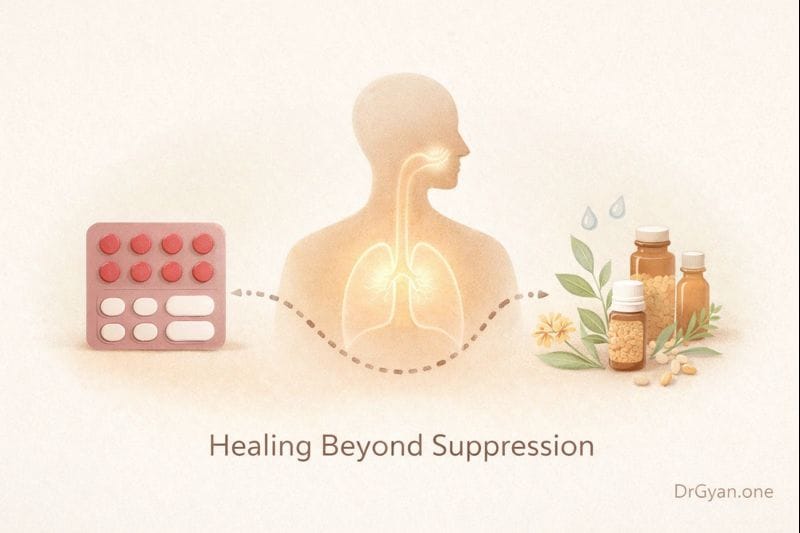
Table of Contents
Introduction: Why Do Allergies Keep Returning?
Millions of people rely daily on antihistamines—cetirizine, levocetirizine, loratadine, montelukast—to control sneezing, itching, watery eyes, asthma, and chronic allergies. Relief often comes quickly, yet the problem quietly persists.
A crucial question arises:
If the medicine works, why does the allergy return the moment it is stopped?
This question marks the beginning of a deeper understanding of healing—one that homeopathy has explored for over two centuries.
Conventional allergy medicines primarily block biochemical reactions. Homeopathy, on the other hand, seeks to understand why the body is reacting in the first place.
This article does not reject modern medicine. Instead, it reframes the conversation—from suppression to individualized immune balance.
The true way to understand, “Homeopathic Alternatives to Antihistamines”.
Understanding Antihistamines: What They Do—and What They Don’t
Antihistamines are designed to block histamine, a chemical released during allergic reactions.
Commonly Used Drugs & Their Target Symptoms
| Drug | Common Use |
|---|---|
| Cetirizine | Sneezing, runny nose |
| Levocetirizine | Hay fever, nasal allergy |
| Loratadine | Itching, watery eyes |
| Montelukast | Asthma, chronic allergy |
The Limitation
- They do not correct immune hypersensitivity
- They require repeated or continuous use
- They may cause drowsiness, dryness, and mood changes
- Long-term use may mask evolving disease patterns
This leads many patients to search for gentler, root-oriented options.
Homeopathy’s Core Principle: Treat the Person, Not the Allergy

Homeopathy does not ask:
“What allergy does the patient have?”
It asks:
“Why is this individual reacting this way?”
Two people with identical symptoms may require entirely different remedies.
Why?
Because homeopathy evaluates:
- Emotional state
- Thermal preference
- Discharge character
- Triggers and time modalities
- Past illnesses and suppressions
Mapping Antihistamines to Homeopathic Thinking (Conceptual, Not Substitution)
⚠️ Important: Homeopathy does not replace drugs symptom-by-symptom.
The following correlations are educational bridges, not prescriptions.
Cetirizine → Homeopathic Perspective on Acute Nasal Allergy
Conventional Focus
Sneezing, runny nose, irritation
Homeopathic Remedies Often Considered
? Allium cepa
- Profuse, watery nasal discharge
- Burning from the nose but bland tears
- Worse in warm rooms, better in open air
? Sabadilla
- Violent sneezing fits
- Sensation of foreign body in nose
- Triggered by cold air
? Euphrasia
- Acrid tears, bland nasal discharge
- Marked eye involvement
? Insight:
Instead of blocking histamine, these remedies aim to educate immune reactivity through similarity.
Levocetirizine → Homeopathy for Hay Fever & Seasonal Allergy
Conventional Focus
Hay fever, pollen allergy
Homeopathic Remedies Considered
? Natrum muriaticum
- Chronic allergies with emotional sensitivity
- Clear, watery discharge like egg white
- Worse in the sun, better in the open air
? Arsenicum album
- Burning discharges
- Anxiety, restlessness
- Symptoms worse after midnight
? Pulsatilla
- Thick yellow-green discharge
- Changeable symptoms
- Better in open air, worse in heat
? Insight:
Here, homeopathy explores the emotional-immune axis, not just the nasal mucosa.
Loratadine → Homeopathic Approach to Itching & Watery Eyes
Conventional Focus
Skin itching, eye watering
Homeopathic Remedies Considered
? Apis mellifica
- Sudden swelling, redness
- Burning, stinging pains
- Worse heat, better cold applications
? Urtica urens
- Nettlerash, hives
- Burning and itching
- Often food-related allergies
? Insight:
Homeopathy recognizes vascular permeability and inflammatory temperament, rather than merely focusing on histamine levels.
Montelukast → Homeopathy in Asthma & Chronic Allergic States
Conventional Focus
Asthma, chronic allergy prevention
Homeopathic Constitutional Remedies
? Phosphorus
- Allergic asthma
- Tall, sensitive individuals
- Fear of being alone
? Natrum sulphuricum
- Damp-weather asthma
- History of suppressed skin issues
? Medorrhinum / Tuberculinum
- Deep-seated miasmatic patterns
- Recurrent infections, allergies since childhood
? Insight:
Chronic allergy is rarely local—it reflects deep systemic imbalance.
Case-Based Understanding (Illustrative)
Case Snapshot
A 32-year-old teacher with:
- Seasonal sneezing for 8 years
- Daily cetirizine use
- Fatigue, emotional sensitivity
- Craving for salt, worse in heat
Homeopathic Evaluation: Natrum muriaticum
Outcome: Reduced frequency of attacks over months, decreased dependence on antihistamines under supervision.
? The focus was pattern, not pollen.
So, this is how Homeopathic Alternatives to Antihistamines can be understood.
Why Suppression Often Backfires Long-Term
Repeated suppression may lead to:
- Migration of disease (nose → chest → skin)
- Increased sensitivity to triggers
- Emotional disturbances
- Chronic dependency
Homeopathy aims for the reverse order of disease resolution, respecting the body’s hierarchy.
Homeopathic Alternatives to Antihistamines: A Philosophical Contrast
| Aspect | Antihistamines | Homeopathy |
|---|---|---|
| Approach | Symptom blocking | Pattern correction |
| Focus | Histamine | Individual response |
| Duration | Short-term | Long-term |
| Dependency | Often continuous | Gradually reduced |
| Healing | Control | Re-education |
Is Homeopathy Anti-Modern Medicine?
Absolutely not.
Homeopathy:
- Respects the need for palliative management when a cure is not possible
- Sometimes needed alongside informed medical guidance
- Encourages conscious reduction, not abrupt stopping
Who Should Consider a Homeopathic Approach?
- Chronic allergy sufferers
- Long-term antihistamine users
- Children with recurrent allergies
- Individuals seeking holistic healing
- Patients with emotional + physical sensitivity
- Patients looking for Homeopathic Alternatives to Antihistamines.
Final Reflection: Healing Is Not Silencing the Body
Allergy is not the enemy.
It is the body’s misguided attempt to protect itself.
True healing lies not in silencing this response—but in correcting its misunderstanding.
Frequently Asked Questions (FAQ)
Q1. Can homeopathy completely replace antihistamines?
In many chronic cases, yes—under professional guidance. Acute emergencies still require conventional care.
Q2. How long does homeopathy take to work for allergies?
Acute relief may occur quickly; chronic correction often takes weeks to months, depending on depth.
Q3. Is it safe to take homeopathy with antihistamines?
Yes. Homeopathy does not chemically interact but should be coordinated with your physician.
Q4. Why can’t one remedy work for everyone?
Because an allergy is an individual condition, not a uniform disease.
Q5. Are these remedies safe for children?
When prescribed correctly by a trained homeopath—yes.
Q6. Does homeopathy suppress symptoms?
No. It aims to normalize immune response, not block it.
Professional Disclaimer
This article is intended for educational purposes only. It does not substitute professional medical advice, diagnosis, or treatment. Homeopathic remedies must be prescribed by a qualified practitioner based on individual evaluation. Do not discontinue prescribed medications without consulting your healthcare provider.