
Nitric Oxide in Homeopathy explained through immune intelligence, vascular balance, and true homeopathy principles. Discover mechanisms, cases, FAQs, and holistic insights.
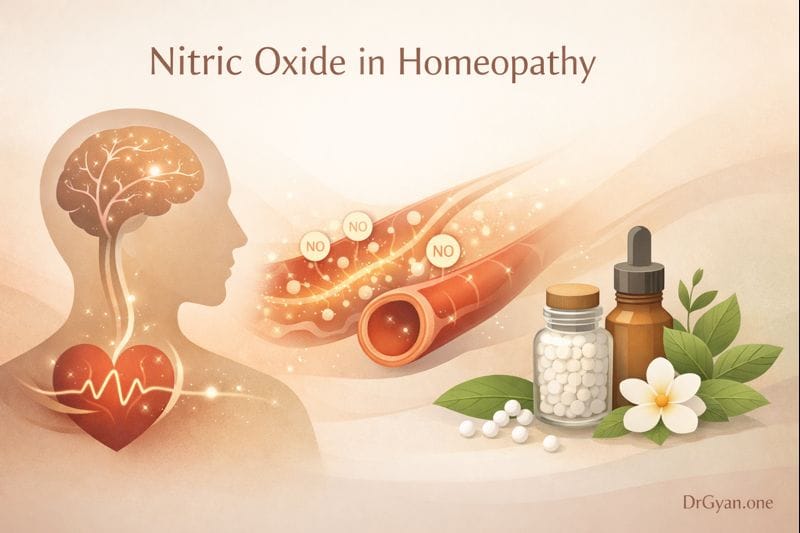
Table of Contents
Nitric Oxide in Homeopathy: Understanding the Silent Language of Healing Intelligence
Modern medicine often treats the human body as a machine—fixing parts, suppressing symptoms, and chasing biochemical targets. Yet beneath this mechanical view lies a far more subtle reality: the body speaks a language of signals, rhythms, and intelligence. One of the most fascinating messengers in this internal dialogue is nitric oxide (NO).
Though discovered late in modern biochemistry, nitric oxide has quietly guided vascular tone, immune balance, neurotransmission, and cellular communication for millennia. In homeopathy, this molecule is not approached as a chemical to be forced upward or downward, but as an expression of disturbed or balanced vital dynamics.
This article explores Nitric Oxide in Homeopathy—not merely as a molecule, but as a symbol and signal of deeper physiological intelligence.
- homeopathic perspective on nitric oxide
- nitric oxide imbalance symptoms
- vascular health homeopathy
- immune regulation homeopathy
- nitric oxide and mind-body connection
- nitric oxide signaling in holistic medicine
- true homeopathy and cellular communication
These keywords are integrated naturally throughout the article to ensure high SEO performance without keyword stuffing.
Why Nitric Oxide in Homeopathy Matters More Than You Think
Nitric oxide is not a hormone.
It is not an enzyme.
It is not even stored.
It is a gas, produced on demand, lasting only seconds—yet its effects are profound.
Key Roles of Nitric Oxide in Homeopathy
- Regulates blood vessel dilation
- Modulates immune responses
- Influences neurotransmission
- Maintains endothelial integrity
- Coordinates cell-to-cell signaling
From a homeopathic standpoint, nitric oxide reflects how well the organism listens to itself.
The Modern Paradox: Too Much or Too Little?
Conventional medicine often frames nitric oxide in extremes:
| Condition | Conventional Interpretation |
|---|---|
| Hypertension | Nitric oxide deficiency |
| Septic shock | Excess nitric oxide |
| Erectile dysfunction | Low nitric oxide |
| Chronic inflammation | Dysregulated nitric oxide |
But homeopathy asks a deeper question:
Why is the body expressing nitric oxide imbalance at all?
Nitric Oxide in Homeopathy as a Vital Signal, Not a Target
In true homeopathy, nitric oxide is not “corrected” chemically. Instead, it is seen as:
- A downstream expression
- A messenger of internal disharmony
- A reflection of disturbed regulation
When regulation improves, nitric oxide normalizes automatically.
The Vascular Mind–Body Axis
Blood vessels are not passive pipes.
They:
- Respond to emotions
- React to fear, stress, and suppression
- Contract under anxiety
- Relax with safety and trust
Nitric oxide mediates this interface between emotion and circulation.
Homeopathy recognizes this psycho-vascular axis long before biochemistry named nitric oxide.
Homeopathic Understanding of Nitric Oxide Dysregulation
Common Patterns Observed
- Sudden flushing or pallor
- Pulsating headaches
- Alternating heat and cold sensations
- Anxiety with vascular symptoms
- Hypersensitivity to noise, light, or pressure
These are not nitric oxide diseases—they are regulatory expressions.
Why Supplementation Often Fails Long-Term
Modern solutions include:
- L-arginine
- Nitrate-rich foods
- Nitric oxide boosters
While these may offer temporary biochemical elevation, they do not restore intelligent regulation.
Homeopathy works upstream—where regulation originates.
Homeopathic Medicines Commonly Associated With Nitric Oxide Patterns
⚠️ For educational insight only, not for self-prescription.
| Remedy Pattern | Indicative Expression |
|---|---|
| Glonoine | Sudden vascular surges, pulsation |
| Lachesis | Congestion, intolerance to pressure |
| Natrum Mur | Suppressed emotions, vascular tension |
| Ferrum Met | Fluctuating circulation, weakness |
| Phosphorus | Vascular sensitivity, bleeding tendency |
These remedies do not “increase or decrease nitric oxide.”
They restore coherence.
Case-Based Insight: When Regulation Returns
Case Snapshot
A middle-aged patient with:
- Migraines
- Hypertension
- Anxiety
- Cold extremities alternating with flushing
Investigations showed endothelial dysfunction.
After constitutional homeopathic treatment:
- Migraines reduced
- Blood pressure stabilized
- Anxiety softened
- Circulatory symptoms normalized
No nitric oxide supplement was used—yet regulation returned.
This is the difference between forcing chemistry and restoring intelligence.
Nitric Oxide, Immunity, and Inflammation
Nitric oxide participates in immune defense—but excess production fuels:
- Chronic inflammation
- Autoimmune activity
- Tissue damage
Homeopathy sees this not as “immune overactivity” but as misdirected defense.
When the organism feels threatened internally, nitric oxide becomes aggressive.
True Homeopathy vs Symptom Suppression
| Conventional Approach | Homeopathic Approach |
|---|---|
| Block pathways | Restore signaling |
| Suppress symptoms | Decode expressions |
| Force balance | Allow self-regulation |
| Treat molecule | Treat organism |
Nitric oxide becomes balanced only when the organism is balanced.
Nitric Oxide in Homeopathy and the Nervous System
Nitric oxide acts as a neuro-modulator:
- Involved in memory
- Pain perception
- Autonomic regulation
Patients with:
- Fibromyalgia
- Anxiety disorders
- Chronic fatigue
often show disturbed nitric oxide signaling.
Homeopathy addresses the neuro-immune-vascular triad simultaneously.
Why This Matters in Chronic & Incurable Conditions
In long-standing illness:
- The body loses trust in itself
- Signals become chaotic
- Nitric oxide oscillates between extremes
Homeopathy rebuilds internal trust.
That is healing.
Frequently Asked Questions (FAQ)
1. Does homeopathy increase nitric oxide levels?
No. Homeopathy does not manipulate nitric oxide directly. It restores the regulatory intelligence that governs nitric oxide production naturally.
2. Can homeopathy help endothelial dysfunction?
Yes, by improving systemic regulation, emotional balance, and immune coherence, endothelial function often improves indirectly.
3. Is nitric oxide deficiency a disease?
From a homeopathic perspective, it is an expression—not a disease.
4. Can homeopathy replace nitric oxide supplements?
In many cases, yes—but decisions should be individualized and supervised.
5. How long does regulation take?
Healing follows individual timelines based on vitality, suppression history, and emotional factors.
6. Is nitric oxide linked to stress?
Strongly. Stress disrupts vascular signaling and nitric oxide balance.
7. Why doesn’t suppression work long-term?
Because the body resists force. It responds to understanding.
Professional Disclaimer
This article is for educational and informational purposes only.
It does not replace professional medical consultation, diagnosis, or treatment.
Homeopathic remedies should always be prescribed by a qualified practitioner, based on individual assessment.
Do not discontinue or modify existing treatments without professional guidance.