
Curative vs palliative treatment explained with clarity—understand the honest choice before taking medicine and how treatment differs from management for long-term health and true healing.
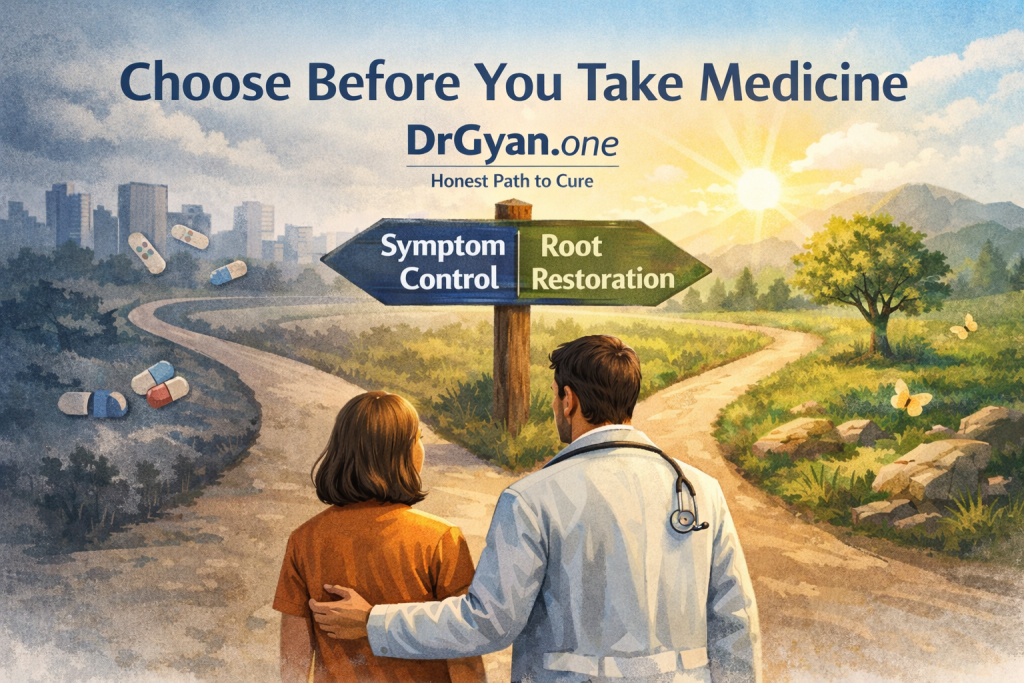
Table of Contents
The Decision You Are Never Told About
Before taking any medicine, there is a decision—silent, unseen, but deeply influential.
Most patients never realize that this decision exists.
They sit across from a doctor, describe their symptoms, receive a prescription, and begin a course of treatment. But what remains unasked—and often unanswered—is this:
Is this medicine meant to cure me, or to manage me?
This is not a small difference.
This is the difference between restoration and dependency, between healing and adjustment, between freedom and continuation.
And every human being has the right to know this—clearly, honestly, and before beginning any medical journey.
The Hidden Divide in Modern Healthcare
In today’s healthcare system, two parallel approaches quietly coexist:
- Curative (Healing-Oriented)
- Palliative (Relief-Oriented)
Similarly, two operational models function side by side:
- Treatment
- Management
These terms are often used interchangeably, but they are not the same.
Curative Approach
A curative approach aims to:
- Remove the root cause
- Restore the natural balance of the body
- End the need for ongoing medication
Its goal is simple:
The patient should not need treatment anymore.
Palliative Approach
A palliative approach aims to:
- Reduce discomfort
- Control symptoms
- Maintain a manageable state
Its goal is different:
The patient should feel better, even if the condition remains.
Treatment vs Management
- Treatment (Curative): Temporary support until the body heals
- Management (Palliative): Ongoing control to maintain stability
This distinction is not just clinical—it is philosophical.
Why Most Patients Never Realize This
If this difference is so important, why is it rarely discussed?
There are several reasons:
1. System Efficiency
Managing symptoms is often faster and more predictable than addressing root causes.
2. Patient Conditioning
Patients have been conditioned to seek quick relief, not long-term understanding.
3. Time Constraints
Modern consultations are often too brief for deep discussions.
4. Lack of Awareness
Many patients simply do not know that a choice exists.
And when awareness is absent, choice disappears.
The Real Risk: Choosing Without Knowing
When a person unknowingly enters a management-based approach, several long-term patterns may emerge:
1. Dependency
Medication becomes a permanent requirement, not a temporary support.
2. Suppression
Symptoms are reduced, but the underlying imbalance may persist.
3. Disease Progression
The condition may:
- Return repeatedly
- Shift form
- Affect deeper systems over time
4. Reduced Vitality
The body may gradually lose its natural responsiveness.
This is not to criticize any system—it is to bring awareness to consequences.
Understanding Suppression: A Subtle but Crucial Concept
Symptoms are often seen as problems.
But in many cases, they are expressions—signals from the body indicating internal imbalance.
When these signals are silenced without resolution, the body does not necessarily heal—it may simply adapt.
For example:
- A recurring skin eruption is suppressed
- The skin clears
- But the internal imbalance remains
Over time, this imbalance may express itself differently.
The key question is:
Was the disease removed, or just redirected?
According to the World Health Organization (WHO), palliative care focuses on improving quality of life by relieving suffering and symptoms, especially in serious illnesses.
Source: https://www.who.int/news-room/fact-sheets/detail/palliative-care
The Decision Point: Before You Take Medicine
This is the most important part of this entire discussion.
Before starting any treatment, every patient deserves a moment of clarity—a decision point.
At this point, ask:
Essential Questions
- Is this approach curative or palliative?
- Will I eventually stop taking this medicine?
- What happens if I discontinue it?
- Is the root cause being addressed?
- Are there alternative approaches available?
These are not difficult questions.
But they require honest answers.
And honesty is the foundation of true healthcare.
Curative vs Palliative: A Clear Comparison
| Aspect | Curative Approach | Palliative Approach |
|---|---|---|
| Goal | Complete healing | Symptom relief |
| Duration | Temporary | Often lifelong |
| Focus | Root cause | Symptoms |
| Outcome | Independence | Dependency |
| Direction | Restoration | Control |
Treatment vs Management: A Practical Comparison
| Aspect | Treatment | Management |
|---|---|---|
| Intent | Cure | Control |
| Timeline | Finite | Ongoing |
| Medication Role | Supportive | Essential |
| End Goal | No medication needed | Continuous use |
When Management Is Truly Necessary
A balanced understanding is essential.
Management is not wrong—it is necessary in certain situations:
- Emergency conditions
- Severe acute states
- Advanced irreversible pathology
- Situations requiring immediate stabilization
In such cases, relief comes before cure.
However, the concern arises when:
Management becomes the default, not the necessity.
Reintroducing the Possibility of Cure
In many chronic conditions, patients are told:
- “This cannot be cured.”
- “You will have to take this lifelong.”
While this may be true in some cases, it is not always universally true.
There exists a space in medicine that asks a different question:
What if the body can heal, if guided correctly?
This is where deeper approaches, including true homeopathy, begin to offer a different perspective.
The Role of True Homeopathy in This Context
When we understand curative intent, we begin to understand the foundation of true homeopathy.
It is not based on:
- Suppressing symptoms
- Forcing biochemical changes
- Replacing body functions
Instead, it works to:
- Stimulate the body’s self-healing intelligence
- Address the individual as a whole
- Restore balance from within
Its goal aligns with the curative approach:
To make the patient free from the need for medicine.
This is not a claim—it is a direction.
And direction matters.
A Shift in Responsibility
Healthcare is not only the responsibility of the doctor.
It is also the responsibility of the patient.
Not in terms of knowledge, but in terms of awareness.
When a patient becomes aware:
- Questions arise
- Clarity increases
- Decisions improve
And with better decisions, outcomes naturally evolve.
Awareness Before Action
The purpose of this discussion is not to reject any system.
It is not to oppose management.
It is not to promote one path blindly.
It is simple to restore a missing element:
Awareness before action
Because once awareness is present, the patient does not need to be convinced.
They can see.
And when one can see clearly, the path becomes self-evident.
The Honest Choice
Every patient stands at a crossroads.
One path offers:
- Immediate relief
- Predictable control
- Ongoing dependence
The other path offers:
- Gradual restoration
- Deeper understanding
- Potential freedom
Neither path is inherently right or wrong.
But choosing without knowing—that is where the problem begins.
Conclusion: Choose Consciously
The question is not:
“Which medicine should I take?”
The real question is:
“What is the intention behind this medicine?”
Because intention shapes outcome.
And outcome shapes life.
Before taking any medicine, pause for a moment.
Ask.
Understand.
Then proceed.
That pause—that awareness—may be the beginning of true healing.
To truly understand the difference between curing and managing a disease, it is important to first define homeopathy treatment and its original intent toward restoration.
Is palliative treatment always wrong?
No. Palliative treatment is essential in situations where immediate relief or stabilization is required. However, it should not replace curative efforts when those are possible.
Can all patients be cured?
Not all conditions can be fully cured, especially in advanced or irreversible stages. However, many conditions may have deeper healing potential than commonly assumed.
How do I know if I am on management-based treatment?
If you need to take medication continuously to keep symptoms under control, it is likely that management. If the goal is to stop medication after recovery, it is curative.
What is suppression in simple terms?
Suppression means reducing or hiding symptoms without addressing the underlying cause. This may lead to recurrence or deeper issues over time.
Where does true homeopathy fit in this?
True homeopathy aligns with the curative approach. It aims to stimulate the body’s natural healing process rather than suppress symptoms.
Disclaimer
This article is intended for educational and informational purposes only. It does not constitute medical advice, diagnosis, or treatment. Always consult a qualified healthcare professional before making any medical decisions. Never disregard professional medical advice or delay seeking it based on information provided here.