Antimicrobial Resistance (AMR) is a growing global concern. Discover its causes, risks, and how holistic and homeopathic approaches support responsible antibiotic use.
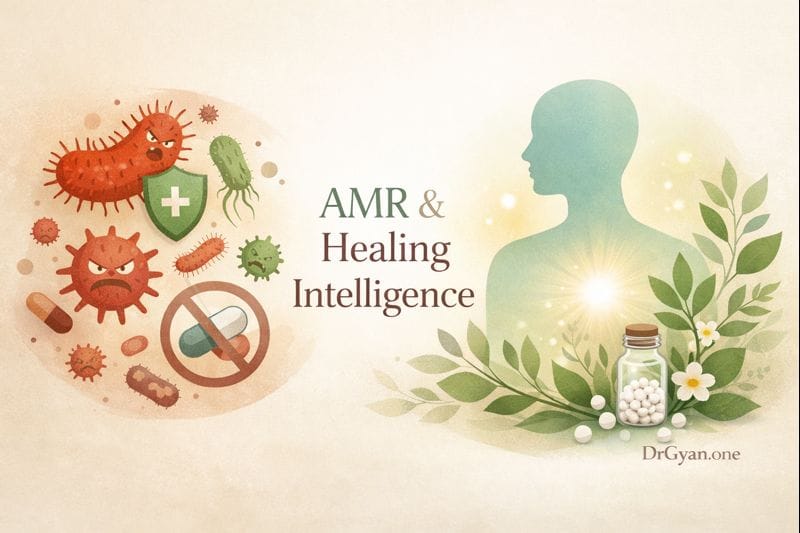
Table of Contents
Introduction: The Crisis We Rarely Hear—but Will All Face
Antimicrobial Resistance (AMR) is advancing quietly, relentlessly, and globally. Unlike pandemics that arrive with sudden waves of fear, AMR grows invisibly—inside hospitals, communities, farms, and even households—until once-treatable infections become life-threatening again.
Modern medicine stands at a paradoxical crossroads. Antibiotics, once hailed as miracle drugs, are losing their power. Routine surgeries, minor wounds, and common infections are becoming increasingly risky. The World Health Organization has repeatedly warned that AMR is among the top ten global public health threats facing humanity.
Yet, while science searches for new drugs, an equally important question remains underexplored:
Can we reduce unnecessary antibiotic dependence by strengthening the body’s own healing intelligence through holistic systems like homeopathy?
This article explores AMR not only as a microbiological phenomenon but as a civilizational warning—and examines the supportive, rational, and ethical role of homeopathy in addressing this crisis.
Understanding Antimicrobial Resistance (AMR)
What Is AMR?
Antimicrobial Resistance occurs when microorganisms—bacteria, viruses, fungi, or parasites—evolve mechanisms that protect them from antimicrobial drugs designed to kill or inhibit them.
In simple terms:
- Medicines stop working
- Infections persist longer
- Transmission risk increases
- Treatment costs escalate
- Mortality rises
AMR is not limited to antibiotics alone, but antibiotic resistance remains the most alarming and widespread component.
How Did We Create This Crisis?
AMR is largely man-made, driven by systemic misuse and misunderstanding.
Key Contributors to AMR
- Overprescription of antibiotics for viral illnesses
- Self-medication and incomplete courses
- Preventive antibiotic use in livestock
- Poor infection control practices
- Lack of individualized treatment approaches
Modern medicine often prioritizes pathogen destruction over patient restoration, creating evolutionary pressure that bacteria inevitably overcome.
The Global Impact of AMR
| Area | Consequence |
|---|---|
| Healthcare | Longer hospital stays, higher mortality |
| Economy | Billions in additional healthcare costs |
| Surgery | Increased post-operative infections |
| Cancer Therapy | Reduced safety of chemotherapy |
| Public Health | Return of untreatable infections |
By 2050, AMR is projected to cause more deaths annually than cancer, disproportionately affecting low- and middle-income populations.
The Deeper Problem: A Reductionist Medical Model
AMR exposes a fundamental flaw in modern healthcare—the overreliance on suppression instead of regulation.
Microbes are not external enemies alone; they are part of ecological systems. Eradicating them indiscriminately destabilizes both human immunity and microbial balance.
This realization opens the door to integrative approaches.
Homeopathy: A Different Scientific Philosophy
Homeopathy is not a replacement for emergency medicine or life-saving antibiotics. However, it offers a preventive and complementary framework that may significantly reduce antibiotic dependence when used appropriately.
Core Principles Relevant to AMR
- Individualized treatment over standardized protocols
- Immune modulation rather than microbial annihilation
- Minimum dose principle, eliminating resistance pressure
- System-level healing, not symptom suppression
Homeopathy does not attack microbes directly. Instead, it stimulates the body’s self-regulatory intelligence, reducing recurrent infections that often lead to repeated antibiotic use.
How Homeopathy May Support the Fight Against AMR
1. Reducing Unnecessary Antibiotic Prescriptions
Many common conditions are self-limiting:
- Upper respiratory infections
- Otitis media (selected cases)
- Viral fevers
- Mild skin infections
Homeopathic management in such cases can:
- Reduce symptom duration
- Lower complication risk
- Avoid premature antibiotic initiation
2. Addressing Recurrence—The Hidden Driver of Resistance
Repeated infections often reflect:
- Weakened immunity
- Poor constitutional resilience
- Suppressed disease expressions
Homeopathy focuses on constitutional strengthening, potentially decreasing recurrence frequency—and thus antibiotic exposure.
3. Post-Antibiotic Recovery Support
After antibiotic courses, patients frequently experience:
- Gut dysbiosis
- Lowered immunity
- Chronic inflammation
Homeopathy, alongside nutrition and lifestyle care, may help restore systemic balance, reducing future infection susceptibility.
4. Community-Level Preventive Potential
In resource-limited settings, rational homeopathic care may:
- Reduce antibiotic misuse
- Lower healthcare burden
- Promote a responsible prescribing culture
Scientific Observations & Integrative Research Trends
While large-scale randomized trials remain limited, emerging areas of interest include:
- Immune signaling modulation
- Nanopharmacology perspectives
- Systems biology correlations
- Observational public health outcomes
Importantly, homeopathy’s non-toxic and resistance-free nature makes it uniquely compatible with AMR-prevention strategies.
Case-Based Insight (Illustrative)
Case: Recurrent Childhood Respiratory Infections
A child with 6–8 antibiotic courses annually develops increasing infection frequency and delayed recovery.
Integrative approach:
- Acute management with supportive care
- Individualized homeopathic prescription
- Nutritional and lifestyle correction
Observed outcome (over 12 months):
- Reduced infection frequency
- Fewer antibiotic requirements
- Improved vitality and recovery speed
The significance lies not in replacing antibiotics—but in needing them less often.
Ethical and Humanitarian Dimensions
AMR disproportionately affects:
- The poor
- The elderly
- Immunocompromised individuals
A healthcare system that relies solely on expensive new drugs risks deepening inequality. Accessible, low-cost, preventive systems deserve ethical consideration—not dismissal.
Integrative Medicine: The Future Path
The solution to AMR will not come from a single discipline.
A Sustainable Strategy Includes:
- Rational antibiotic stewardship
- Strong public education
- Preventive healthcare models
- Immune-focused therapies
- Responsible integration of homeopathy
The goal is medical pluralism guided by evidence, ethics, and a spirit of humility.
Conclusion: Listening to the Warning
Antimicrobial Resistance is not merely a scientific issue—it is a mirror reflecting our medical excesses.
Homeopathy’s role lies not in opposition to science, but in complementing it, reminding us that:
- The body is not a battlefield
- Healing is not always suppression
- Prevention is the highest medicine
If humanity is to survive the post-antibiotic era, we must heal smarter—not harder.
Frequently Asked Questions (FAQ)
1. Is Antimicrobial Resistance really that serious?
Yes. AMR threatens to make common infections deadly again and is considered a major global health emergency.
2. Can homeopathy replace antibiotics?
No. Homeopathy is not a substitute for antibiotics in severe or life-threatening infections. It plays a supportive and preventive role.
3. How does homeopathy avoid resistance?
Homeopathic medicines do not act by killing microbes, so they do not create resistance pressure.
4. Can homeopathy help reduce antibiotic overuse?
When used appropriately, it may help manage self-limiting conditions and recurrent infections, reducing unnecessary antibiotic use.
5. Is there scientific research on this topic?
Research is evolving, especially in immune modulation and systems biology. More integrative studies are needed.
6. Is homeopathy safe alongside conventional treatment?
Under qualified supervision, it is generally safe and compatible with conventional care.
Professional Disclaimer
This article is intended for educational and informational purposes only. It does not replace professional medical advice, diagnosis, or treatment. Antibiotics remain essential and life-saving in many conditions. Any integrative or homeopathic approach should be undertaken under the guidance of qualified healthcare professionals. Never delay or discontinue prescribed medical treatment without consulting your physician.